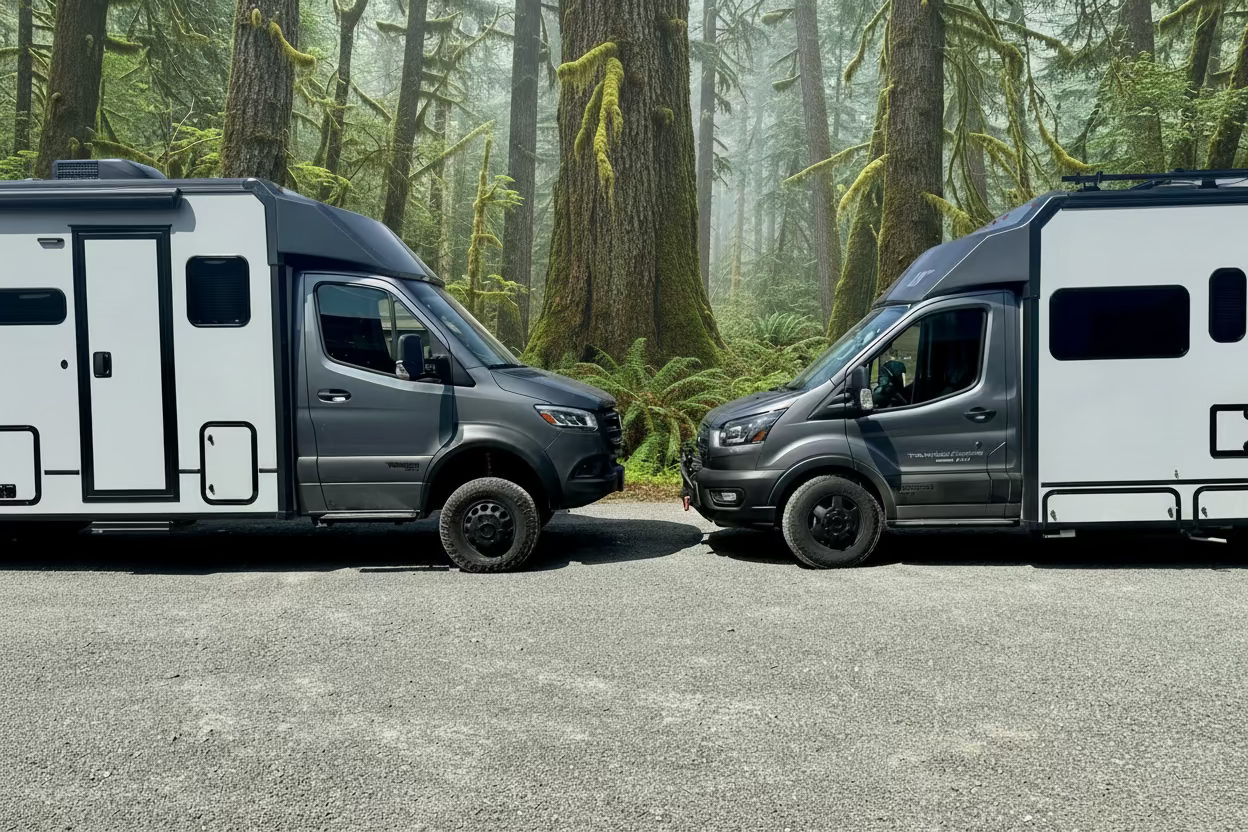

Duals aren't a requirement
A super single conversion swaps the dual rear wheels on a 3500 Sprinter, Ekko, Open Trail, or Transit for one load-rated wheel and tire per side.
People treat duals like a law of physics. They're not. Load rating and operating pressure carry the axle. Tire count doesn't.
That doesn't mean every DRW van should convert. Weight, terrain, and whether you'll actually air down decide it.

Why Owners Choose a Super Single Conversion
- Ride Quality: Larger tire absorbs bumps better than dual sidewalls.
- Off-Road Grip: Wider patch outperforms DRW in loose terrain.
- Air-Down Ease: Boosts comfort/traction.
- Maintenance Savings: Fewer tires mean lower costs.
- Spare Simplicity: One size fits all.
- Debris: Duals pack with mud, snow, and rocks.
A super single conversion isn't for everyone. But, if these pain points resonate with you, dropping the duallies might be the right move.

Keep the Duals If...
- The van lives at max GVWR
- Almost every mile is highway
- You won't install onboard air or you won't air down
- The spare is an afterthought

Super Single Considerations
A correct super single conversion is not just wheels and tires. It includes:
- Load-rated components
- Wheel well and clearance modifications
- Proper PSI setup
- Air management
- TPMS monitoring
- A plan for the spare tire
- A scale ticket
- Validation against real axle weights
Our formula is based on ownership of these platforms and hundreds of happy clients who have converted because it fit their use case.

Our Picks
Super Single Tires
- Toyo Open Country R/T Trail 295/70R17
- Falken Wildpeak AT3W 295/70R17
Chosen for proper load ratings, durability, predictable handling, and off-pavement capability.
Super Single Wheels
- Reika Rambler or Marauder 3500
- Owl Vans Talon
Wheel Well Modifications
- Mondo Big Wheel Kit
- Wheel well modifications to prevent rubbing
Spare Tire Solution
- Larger spare tire basket
- Rear tire carrier

Transit Super Single
Transit Tire
- Continental Vancontact 285/65/16
Transit Wheels
- Reika Wheels
Relatively new, the Transit Super Single continues to show opportunity to enhance it's off-pavement capability.
Get in touch
Complete the form below or book a consultation instantly
Instant BookingFrequently Asked Questions
One load-rated wheel and tire per rear side instead of duals, on a 3500 Sprinter, Ekko, or Transit DRW. Four tires on the ground instead of six. Same spare at every corner.
No. Duals are one way to meet the axle rating. A properly rated single tire, at the right PSI, is another. Tire count doesn't carry the van. Load rating does.
Most owners see little change, or a slight gain, once you correct for the new tire size. You lose dual-tire scrub. You add a taller, wider tire. Those two often cancel.
We typically recommend staying with duals if the vehicle consistently operates at absolute maximum GVWR or your driving is primarily highway.
A correctly spec'd conversion doesn't void the whole vehicle warranty. Wear items can still wear. We don't sell this as a loophole.
Most conversions land between $5,000 and $7,000+, depending on wheels, tires, well work, air, TPMS, and speedo correction.